
DIY / Pillar Pages
The Complete Fix-It & Cleaning Kit — Under AED 200
A useful home kit is small, labelled and matched to the finishes you actually own. This under-AED-200 framework prioritises basic hand tools, clean cloths, controlled application and manufacturer-approved supplies instead of a shelf of improvised chemistry. Each linked guide states the exact compatibility check, product type and stop condition for the task it covers.
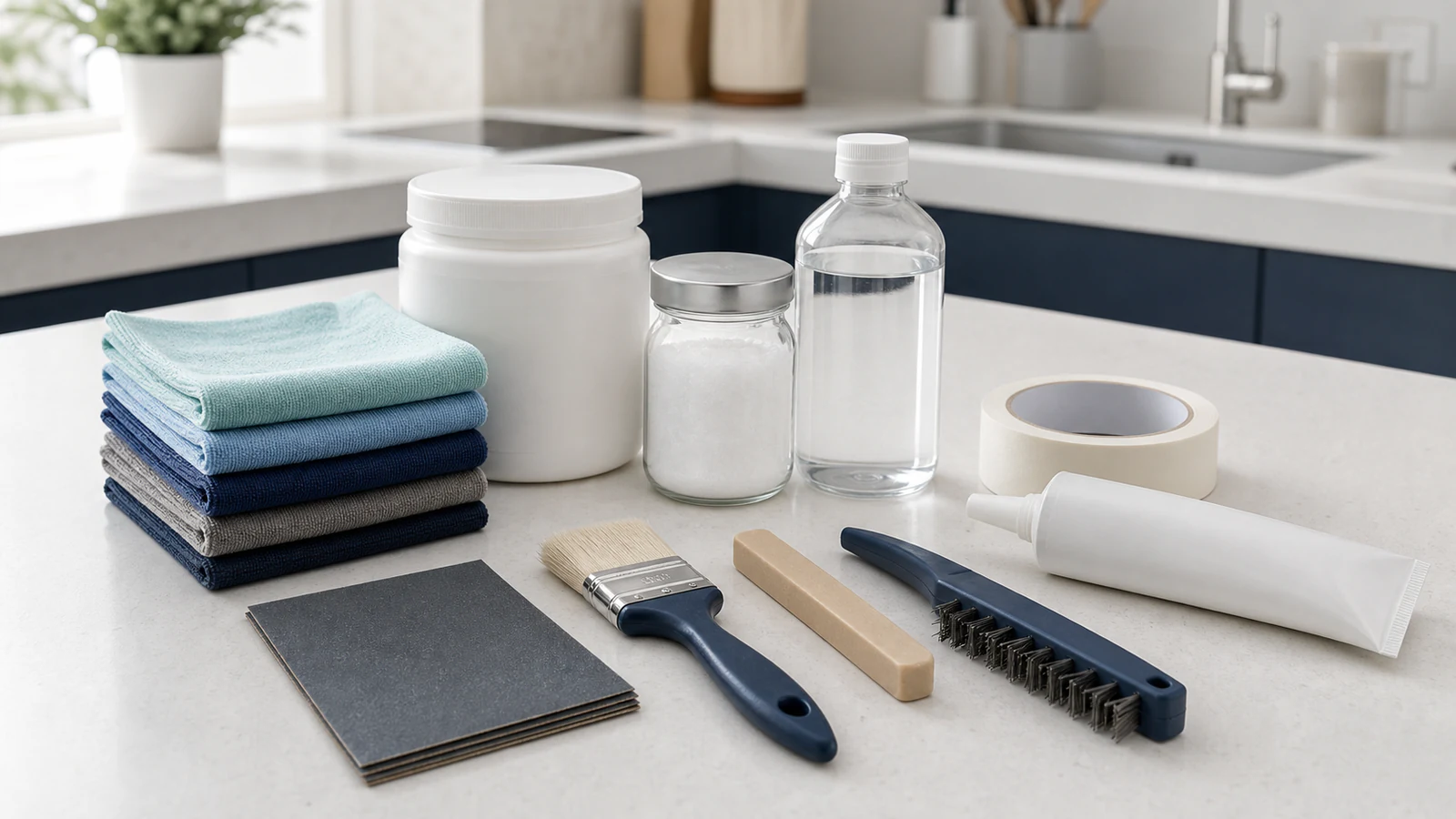
Quick answer
What should be in a basic home tool kit?
Start with microfibre cloths, a soft brush, masking tape, a small screwdriver set, hex keys, a torch, gloves and eye protection. Add only the labelled cleaner, filler, adhesive or lubricant approved for a confirmed surface and task. Keep the total under AED 200 by buying problem-specific supplies after diagnosis, not before.
Kitchen countertops / Bathroom tiles and grout / Stainless steel and chrome fixtures / Hardwood and laminate floors / Painted drywall / Ceramic and glass surfaces
Marble, limestone and natural stone surfaces / Sealed wooden furniture / Anodised aluminium / Polished brass and antique metals
Room-by-room library
Start with the surface or problem in front of you.
Each section gives the direct rule first, then points to the complete photographed fixes in this cluster.
-
What cleaning products do I actually need?
Choose a small kit around repeatable, low-risk jobs, then match every cleaner, brush and tool to the material and the manufacturer instructions before using it. How to Clean a Greasy Oven Safely — Is Baking Soda Allowed?: Do not choose a universal dwell time. Use baking soda only when the exact oven manual permits it, at that manual's ratio and time; Samsung documents equal parts baking soda and water for 20 minutes on certain ovens. Other makers prohibit that shortcut or require a built-in cycle. Keep every cleaner off elements, vents, seals and unapproved liners. Cloudy Shower Glass: A Finish-Safe Hard-Water Cleaning Method: Identify the enclosure and coating first. Wipe with a soft cloth and mild detergent diluted in warm water, then rinse and squeegee dry. Use a hard-water cleaner only when the glass manufacturer approves that exact product and dwell time. Stop for chips, cracks, coating changes or haze that remains after two gentle cleans. How to Restore Shine to a Dull Countertop (Quartz vs. Marble): Confirm the exact material, finish and manufacturer, then use its approved neutral cleaner and a soft cloth. Patch-test first, rinse and dry as directed. Use a polish only when the maker explicitly approves one for that product. Acid can etch calcite-based stone; physical etching, abrasion, heat damage and resin damage need specialist assessment. Remove Rust Stains from Bathroom Tiles Safely: Confirm intact glazed ceramic or porcelain and a small transfer stain. Try the tile maker's routine cleaner first. If needed, use only its approved rust product, following the label for PPE, testing, dwell and rinsing. Stop for recurrence, pitting, cracks or leaks.
-
Which repair tools do every apartment owner need?
How to Fill Nail Holes in a Wall So They Disappear: On sound, dry drywall or plaster, use compatible ready-mix filler with a clean filling knife. Follow its stated depth, layer and dry-time limits, then sand only the minimum needed with dust controls before applying matching paint. Stop for dampness, crumbling, cracks or a suspected cable or pipe path. Peeling Edge Strip on a Countertop: Reattach It With Contact Adhesive: Use only a contact adhesive approved for both the edge band and board. Ventilate, remove ignition sources, wear label-specified PPE, coat both clean dry surfaces thinly, wait for the exact label-defined tack stage, then align and press once. Do not repair swollen, soft or mould-affected board. Peeling Natural-Wood Veneer: A Small Edge Repair: Use only a PVA wood glue whose maker confirms the two clean bare-wood surfaces are compatible. Hidden-test the finish, apply the label-directed amount to one small dry lift, hold it with the approved pressure method and observe the full clamp and cure times. Do not use super glue or repair wet, coated or damaged material. How to Whiten Dark Floor Grout Without Machines: Identify the tile, grout and sealer, then hidden-test their approved neutral or alkaline grout cleaner at the exact label dilution. Work in small sections with a soft nylon grout brush, use only the stated dwell time, rinse until no residue remains and dry the floor. Stop for softness, crumbling, colour loss, dampness or mould.
-
How much will a complete starter kit actually cost?
How to Clean a Greasy Oven Safely — Is Baking Soda Allowed?: Do not choose a universal dwell time. Use baking soda only when the exact oven manual permits it, at that manual's ratio and time; Samsung documents equal parts baking soda and water for 20 minutes on certain ovens. Other makers prohibit that shortcut or require a built-in cycle. Keep every cleaner off elements, vents, seals and unapproved liners. How to Whiten Shower Grout — The Full Method: Identify the tile and grout, then use a neutral tile-and-grout cleaner approved by their manufacturers. Patch-test, apply at the label dilution, agitate gently with a soft hand brush, rinse thoroughly and dry. Stop if grout is cracked, missing, soft, powdery, persistently wet or changes colour during the test. How to Descale a Kettle Safely: Is Citric Acid Allowed?: Use citric acid only if the exact kettle manual approves it or specifies a compatible citric-acid descaler. Follow the stated dose, water level, heating or no-heating step, contact time and rinse sequence. Keep the base and connectors dry, allow hot liquid to cool, and stop for leaks, coating damage or failed shutoff.
-
What problems can each item solve in my kitchen?
How to Clean a Greasy Oven Safely — Is Baking Soda Allowed?: Do not choose a universal dwell time. Use baking soda only when the exact oven manual permits it, at that manual's ratio and time; Samsung documents equal parts baking soda and water for 20 minutes on certain ovens. Other makers prohibit that shortcut or require a built-in cycle. Keep every cleaner off elements, vents, seals and unapproved liners. How to Remove Limescale From a Tap Without Damaging the Finish: Check the exact faucet care guide before using vinegar. If it permits vinegar, use its stated dilution and contact time; Kohler specifies a 50/50 white-vinegar-and-warm-water solution on a soft cloth for about 5–10 minutes. Rinse immediately and dry. If the maker prohibits acetic acid or the finish is unknown, use its approved cleaner instead. Sticky Grease on Kitchen Cabinets: Clean It Without Ruining the Finish: Identify the cabinet finish and check its care guide. Start with a soft cloth barely dampened with warm water; use only the maker-approved dilution of mild dish soap if needed. Apply liquid to the cloth, not the door, then wipe with clean water and dry immediately. Stop for colour transfer, tackiness, swelling or sheen change. How to Polish a Dull Stainless Steel Sink in 20 Minutes: Confirm the basin is uncoated stainless steel, then wash it with the maker-approved mild cleaner and a soft nonabrasive cloth, working with the grain. Rinse immediately and dry completely. If it remains dull, use only the stainless-steel cleaner or polish named by the manufacturer. Stop for pits, rust that returns, coating change, sharp edges or leaks. Peeling Edge Strip on a Countertop: Reattach It With Contact Adhesive: Use only a contact adhesive approved for both the edge band and board. Ventilate, remove ignition sources, wear label-specified PPE, coat both clean dry surfaces thinly, wait for the exact label-defined tack stage, then align and press once. Do not repair swollen, soft or mould-affected board.
-
What problems can each item solve in my bathroom?
Brown Ring in the Toilet Bowl: A Glaze-Safe Cleaning Method: Confirm the bowl is intact vitreous china and remove any in-tank product. Flush away previous cleaner, ventilate, then apply only a toilet-bowl hard-water cleaner approved by the fixture maker. Follow its label for amount and contact time, brush with nylon, flush and rinse. Stop for cracks, glaze change or an unknown prior chemical. Cloudy Shower Glass: A Finish-Safe Hard-Water Cleaning Method: Identify the enclosure and coating first. Wipe with a soft cloth and mild detergent diluted in warm water, then rinse and squeegee dry. Use a hard-water cleaner only when the glass manufacturer approves that exact product and dwell time. Stop for chips, cracks, coating changes or haze that remains after two gentle cleans. How to Whiten Shower Grout — The Full Method: Identify the tile and grout, then use a neutral tile-and-grout cleaner approved by their manufacturers. Patch-test, apply at the label dilution, agitate gently with a soft hand brush, rinse thoroughly and dry. Stop if grout is cracked, missing, soft, powdery, persistently wet or changes colour during the test. How to Make Chrome Taps Shine Like New in 10 Minutes: Confirm the faucet is intact chrome, then wipe it with a soft cloth dampened with water and a small amount of mild liquid dish soap. Rinse immediately with a second damp cloth and dry completely. Do not use vinegar, limescale remover, abrasive pads or wax unless the exact faucet manufacturer approves them. Remove Rust Stains from Bathroom Tiles Safely: Confirm intact glazed ceramic or porcelain and a small transfer stain. Try the tile maker's routine cleaner first. If needed, use only its approved rust product, following the label for PPE, testing, dwell and rinsing. Stop for recurrence, pitting, cracks or leaks.
-
How do I store and maintain my kit safely?
How to Clean a Greasy Oven Safely — Is Baking Soda Allowed?: Do not choose a universal dwell time. Use baking soda only when the exact oven manual permits it, at that manual's ratio and time; Samsung documents equal parts baking soda and water for 20 minutes on certain ovens. Other makers prohibit that shortcut or require a built-in cycle. Keep every cleaner off elements, vents, seals and unapproved liners. How to Descale a Kettle Safely: Is Citric Acid Allowed?: Use citric acid only if the exact kettle manual approves it or specifies a compatible citric-acid descaler. Follow the stated dose, water level, heating or no-heating step, contact time and rinse sequence. Keep the base and connectors dry, allow hot liquid to cool, and stop for leaks, coating damage or failed shutoff. Peeling Edge Strip on a Countertop: Reattach It With Contact Adhesive: Use only a contact adhesive approved for both the edge band and board. Ventilate, remove ignition sources, wear label-specified PPE, coat both clean dry surfaces thinly, wait for the exact label-defined tack stage, then align and press once. Do not repair swollen, soft or mould-affected board.
-
Can I use these products on every surface?
How to Restore Shine to a Dull Countertop (Quartz vs. Marble): Confirm the exact material, finish and manufacturer, then use its approved neutral cleaner and a soft cloth. Patch-test first, rinse and dry as directed. Use a polish only when the maker explicitly approves one for that product. Acid can etch calcite-based stone; physical etching, abrasion, heat damage and resin damage need specialist assessment. Pen, Marker and Grease Marks on Walls: A Paint-Safe Cleaning Ladder: Check that the paint is intact and washable, then test behind furniture. Blot grease with a barely damp cloth and mild dish-soap solution. For ink or marker, follow the paint maker's named spot-cleaning product and method. Stop if colour, sheen or texture changes. Scuff Marks on Walls: The Gentle-to-Strong Cleaning Ladder: Start dry on intact, fully cured, washable paint. Hidden-test each escalation before using a soft cloth with mild soapy water or a paint-maker-approved eraser. Use minimal pressure and moisture. Stop if colour transfers, the finish softens, or its sheen changes.
What you need
Select by room and task
Use the linked guides as the shopping list. Prices are planning ranges in AED, not a reason to substitute an unlabelled product. Buy the smallest original container that covers the confirmed task, retain its instructions and receipt, and store it closed in the labelled conditions away from heat, food, children and pets.
- Descaling
- Citric acid is safer than vinegar on descaling taps and kettle interiors because it does not pit chrome or stainless steel over time.
- Glass and screens
- 70% isopropyl alcohol evaporates quickly and does not leave streaks on glass, mirrors or screens.
- Adhesive cure
- Contact adhesive cures in 24 hours and bonds peeling veneer more securely than wood glue alone.
- Dusting
- Microfibre cloths trap dust and grime without scratching polished or glossy finishes.
Baking soda (1 kg)
1 kg
Citric acid powder (200 g)
200 g
Isopropyl alcohol 70% (500 ml)
500 ml
Microfibre cloth pack (5 cloths)
5 cloths
Bar Keepers Friend (400 g)
400 g
Wood filler stick (neutral)
1 stick
Contact adhesive (125 ml tube)
125 ml
Masking tape (48 mm × 50 m)
1 roll
Paintbrush 25 mm synthetic
1
Fine sandpaper pack (80–220 grit)
1 pack
Soft-bristle wire brush
1
Silicone-based furniture polish (250 ml)
250 ml
Plastic adhesive hooks (pack of 5)
5 hooks
Typical UAE retail ranges. Prices vary by pack and store, and your total is lower when you already own the reusable tools.
Quick answers
Frequently asked questions.
What should be in a basic home tool kit?
A basic kit needs clean microfibre cloths, a soft brush, masking tape, a small screwdriver set, hex keys, a torch, gloves and eye protection. Add a maker-approved cleaner, filler, adhesive or lubricant only for a confirmed task. Avoid building a universal chemical kit for unidentified surfaces.
How much does a starter cleaning kit cost?
Set an AED 200 ceiling and buy reusable hand tools first. Reserve the amount for one or two task-specific supplies after identifying the material and fault. UAE prices vary by brand and retailer, so treat every listed figure as a planning range and compare the exact labelled product, not substitutes.
What are the most useful cleaning products?
The most useful supplies are clean microfibre cloths, a soft brush and the exact neutral or manufacturer-approved cleaner for a confirmed finish. They support controlled cleaning without pretending one chemical suits every room. For scale, grout, metal, paint, wood or appliances, follow the separate guide and product label.
Can I mix cleaning products together?
No. Use one labelled product at a time and keep it in its original container. Never mix bleach with acids, ammonia, alcohol or another cleaner. Do not combine baking soda with an acid as a formula. Remove or rinse a product exactly as labelled, let the surface dry, then reassess.
Sources and review notes
- Bosch: What Oven Cleaner Should I Use? - Manufacturer guidance for warm soapy water, spot cleaning and model-specific self-cleaning.
- Samsung: How to Clean a Samsung Oven - Manufacturer instructions for cool surfaces, nonabrasive tools and a short baking-soda method on covered models.
- Whirlpool AquaLift Clean Cycle Instructions - Primary instructions requiring measured water without chemical additives and a complete cool-down.
- KOHLER: How to Clean Glass Shower Doors - Manufacturer guidance for mild diluted detergent, squeegeeing and drying shower doors to limit water spots and lime buildup.
- Guardian Glass: ShowerGuard Cleaning Manual - Coated-glass manufacturer guidance showing that maintenance and accepted products depend on the specific protective surface.
- Caesarstone quartz surface care and maintenance - Manufacturer guidance for cleaning engineered quartz and avoiding unsupported polishing methods.
- Natural Stone Institute: natural stone care - Industry guidance on identifying stone, avoiding acids on calcite-based materials and escalating etching.
- Daltile: Care and maintenance of ceramic and porcelain tile - Tile-manufacturer guidance to identify the surface, use suitable products, test first and rinse residues.
- American Olean: Porcelain tile care and maintenance - Manufacturer care guidance supporting product compatibility checks and non-abrasive cleaning.
- DAP DryDex Spackling Technical Data Sheet - Manufacturer application, drying, sanding and substrate requirements.
- US EPA: Renovation, Repair and Painting Program for Consumers - Lead-dust risk and lead-safe practices when sanding older painted surfaces.
- Formica laminate assembly and edge-banding guidance - Manufacturer guidance to follow the adhesive instructions, coat matching surfaces and apply pressure with a roller.