
DIY / Pillar Pages
One Hour of Small Fixes That Beats a Full Day of Cleaning
A focused hour can improve a home when the jobs are small, independent and already diagnosed. Choose visible issues that need simple surface care or an accessible hand-tool adjustment, gather only the approved materials, and give every task a stop condition. The linked guides keep a quick win from expanding into unsafe electrical, plumbing, structural or finish work.
Quick answer
What small fixes make the biggest difference at home?
Choose several independent jobs that each have a confirmed material, approved method and safe reach: tighten accessible non-safety hardware, clean an intact compatible surface, or complete a small cosmetic repair. Prepare first, follow each guide separately and stop the clock whenever you find leakage, movement, damaged parts, unknown finishes, wiring, mould recurrence or unstable access.
Room-by-room library
Start with the surface or problem in front of you.
Each section gives the direct rule first, then points to the complete photographed fixes in this cluster.
-
Why do loose handles and sticky doors matter so much?
Prioritise small faults that are visible every day, can be reached safely and have a clear stop condition. A short, focused repair should not become an improvised renovation. Loose Door Handle: The Hidden Set Screw: Locate the set screw hidden in a small hole on the handle neck, usually on the side or underside. Insert the correct-sized Allen key or screwdriver and turn clockwise until snug. Do not overtighten. Test the handle to confirm it engages the latch properly. Squeaky Door Hinges — and Why WD-40 Isn't the Answer: WD-40 is a brand with several products; its Multi-Use formula is not the same as a dedicated hinge lubricant and may only quiet noise temporarily. Check the door or hinge maker, then use one tiny drop of an explicitly approved lubricant. Stop for loose, worn, fire-rated, security or self-closing hinges. Stuck Kitchen Drawer? Identify and Clean the Runners Safely: Empty and support the drawer, identify the runner model and follow its removal instructions. Vacuum accessible dust without removing factory grease, keep fingers clear and reinstall exactly as documented. Do not add wax, silicone spray or penetrating oil unless that runner's manufacturer explicitly specifies it. Stop for bent, broken, swollen or unsupported parts.
-
How do taps and chrome fixtures look new again?
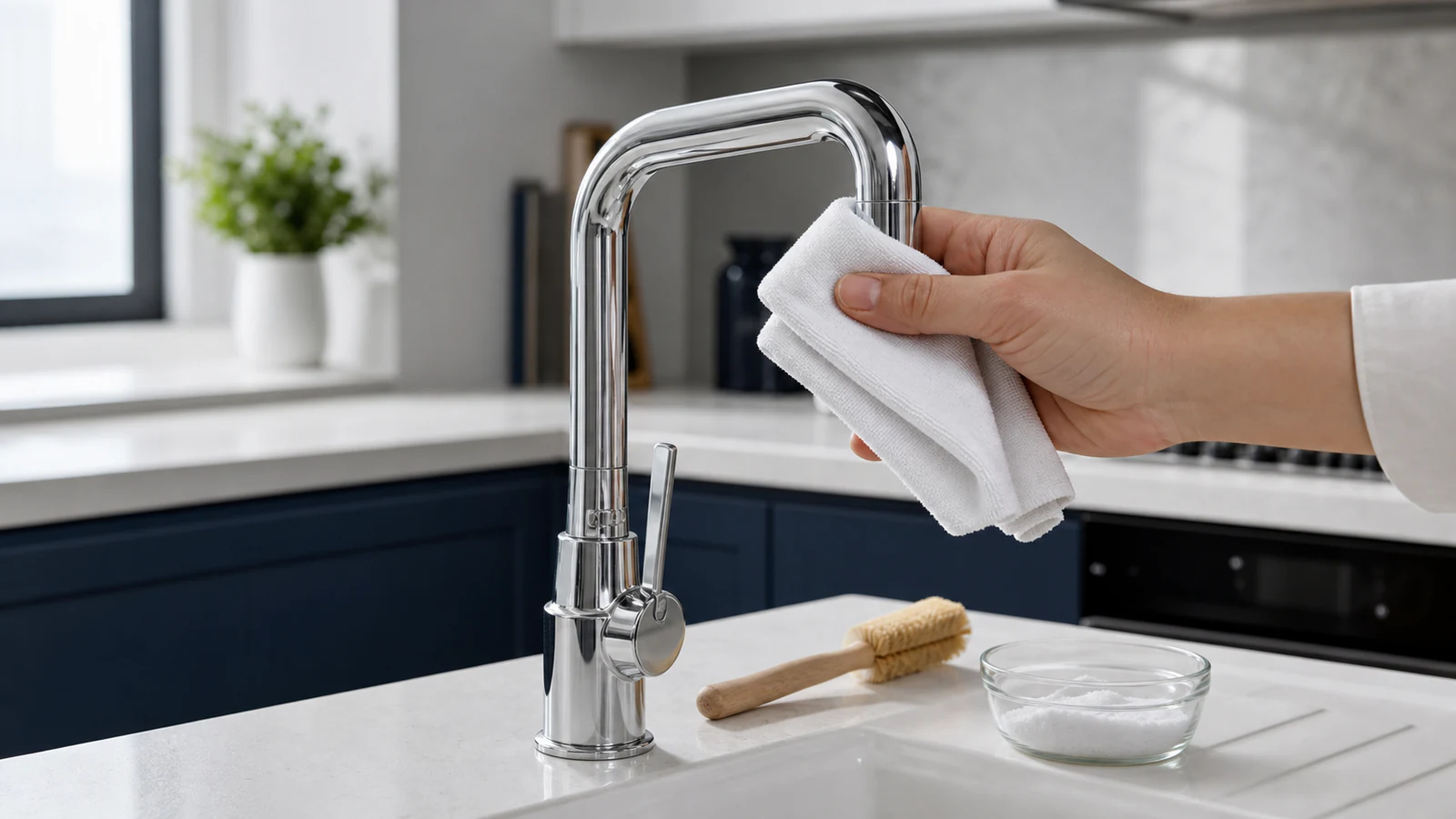
How to Remove Limescale From a Tap Without Damaging the Finish: Check the exact faucet care guide before using vinegar. If it permits vinegar, use its stated dilution and contact time; Kohler specifies a 50/50 white-vinegar-and-warm-water solution on a soft cloth for about 5–10 minutes. Rinse immediately and dry. If the maker prohibits acetic acid or the finish is unknown, use its approved cleaner instead. How to Make Chrome Taps Shine Like New in 10 Minutes: Confirm the faucet is intact chrome, then wipe it with a soft cloth dampened with water and a small amount of mild liquid dish soap. Rinse immediately with a second damp cloth and dry completely. Do not use vinegar, limescale remover, abrasive pads or wax unless the exact faucet manufacturer approves them. How to Polish a Dull Stainless Steel Sink in 20 Minutes: Confirm the basin is uncoated stainless steel, then wash it with the maker-approved mild cleaner and a soft nonabrasive cloth, working with the grain. Rinse immediately and dry completely. If it remains dull, use only the stainless-steel cleaner or polish named by the manufacturer. Stop for pits, rust that returns, coating change, sharp edges or leaks.
-
What makes yellowed light switches and outlets look clean?
Yellowed Light Switches: The Safe Way to Clean Them: If the switch is intact, cool, dry and silent, turn the light off and wipe only its solid external face with a soft cloth barely dampened in label-diluted mild detergent. Never spray, remove the cover or wet gaps. Aged yellow plastic needs electrician-approved replacement, not bleaching.
-
How do you fill holes and small imperfections invisibly?
How to Fill Nail Holes in a Wall So They Disappear: On sound, dry drywall or plaster, use compatible ready-mix filler with a clean filling knife. Follow its stated depth, layer and dry-time limits, then sand only the minimum needed with dust controls before applying matching paint. Stop for dampness, crumbling, cracks or a suspected cable or pipe path. Touch-Up Paint That Doesn't Look Like a Patch: Match the exact paint colour, product and sheen, then use the same brush or roller texture as the original coat. Hidden-test first and assess only after the label's full dry time. If the patch still shows, stop enlarging it and paint to a natural boundary instead.
-
Why does grout and countertop finish matter in 60 minutes?
How to Restore Shine to a Dull Countertop (Quartz vs. Marble): Confirm the exact material, finish and manufacturer, then use its approved neutral cleaner and a soft cloth. Patch-test first, rinse and dry as directed. Use a polish only when the maker explicitly approves one for that product. Acid can etch calcite-based stone; physical etching, abrasion, heat damage and resin damage need specialist assessment. How to Brighten Dark Grout on a Kitchen Backsplash Safely: Identify the tile, grout and sealer, then use a pH-neutral cleaner labelled for all three. Apply it at the label dilution, agitate gently with a soft nylon brush, rinse fully and let the grout dry before judging the colour. If sound grout is still discoloured, use only a compatible labelled grout colourant and follow its preparation and cure instructions. How to Whiten Dark Floor Grout Without Machines: Identify the tile, grout and sealer, then hidden-test their approved neutral or alkaline grout cleaner at the exact label dilution. Work in small sections with a soft nylon grout brush, use only the stated dwell time, rinse until no residue remains and dry the floor. Stop for softness, crumbling, colour loss, dampness or mould.
-
What small appliance and fixture tricks work in minutes?
How to Steam-Clean a Microwave with a Model-Approved Water Bowl: Check the exact microwave manual for a water-bowl or steam-clean method. Use its microwave-safe vessel, water volume, additives, power and time without improvising. Stay nearby, let the bowl stand as directed, open the door cautiously, and remove it with dry oven gloves. If no method is documented, use the approved cool-cavity wipe instead. Carpet Dents From Furniture: The Ice Cube Trick: Check the carpet maker first. If it confirms a colourfast synthetic pile and permits light water treatment, hidden-test one ice cube, blot it dry and wait for complete drying. Treat only a small dent, then gently stroke the pile with a coin edge. Never use heat, soak the backing or repeat on slow-drying carpet. How to Clean a User-Serviceable AC Filter and Restore Airflow: Confirm in the exact model manual that the filter is user-removable and washable. Switch the unit off, remove the filter only as shown, vacuum or rinse it as directed, shade-dry it fully, and reinstall it in the original orientation. Stop for unsafe access, damage, leaks, ice, odour or exposed wiring.
-
How do sticky or damaged furniture pieces get refreshed?
Wobbly Chairs and Scratching Legs: Tighten + Felt Pads: Inspect first. If every part and joint is sound, follow the maker's sequence and hand-tighten accessible fasteners with the correct tool. Fit floor-compatible pads to clean, dry leg ends. Stop for cracks, stripped inserts, loose glued joints, bent legs or continuing wobble. Peeling Edge Strip on a Countertop: Reattach It With Contact Adhesive: Use only a contact adhesive approved for both the edge band and board. Ventilate, remove ignition sources, wear label-specified PPE, coat both clean dry surfaces thinly, wait for the exact label-defined tack stage, then align and press once. Do not repair swollen, soft or mould-affected board. Peeling Natural-Wood Veneer: A Small Edge Repair: Use only a PVA wood glue whose maker confirms the two clean bare-wood surfaces are compatible. Hidden-test the finish, apply the label-directed amount to one small dry lift, hold it with the approved pressure method and observe the full clamp and cure times. Do not use super glue or repair wet, coated or damaged material.
-
What is the psychological effect of these quick wins?
Loose Door Handle: The Hidden Set Screw: Locate the set screw hidden in a small hole on the handle neck, usually on the side or underside. Insert the correct-sized Allen key or screwdriver and turn clockwise until snug. Do not overtighten. Test the handle to confirm it engages the latch properly. How to Remove Limescale From a Tap Without Damaging the Finish: Check the exact faucet care guide before using vinegar. If it permits vinegar, use its stated dilution and contact time; Kohler specifies a 50/50 white-vinegar-and-warm-water solution on a soft cloth for about 5–10 minutes. Rinse immediately and dry. If the maker prohibits acetic acid or the finish is unknown, use its approved cleaner instead. Yellowed Light Switches: The Safe Way to Clean Them: If the switch is intact, cool, dry and silent, turn the light off and wipe only its solid external face with a soft cloth barely dampened in label-diluted mild detergent. Never spray, remove the cover or wet gaps. Aged yellow plastic needs electrician-approved replacement, not bleaching. How to Fill Nail Holes in a Wall So They Disappear: On sound, dry drywall or plaster, use compatible ready-mix filler with a clean filling knife. Follow its stated depth, layer and dry-time limits, then sand only the minimum needed with dust controls before applying matching paint. Stop for dampness, crumbling, cracks or a suspected cable or pipe path.
Quick answers
Frequently asked questions.
What small fixes make the biggest difference at home?
The gains come from faults you see or touch every day and can address within a verified surface-level scope: an accessible loose interior handle, an intact dirty track, a cosmetic hole or a compatible dull fixture. Choose by diagnosis and safety boundary, not by a viral shortcut or completion time.
What can you fix in an apartment in one hour?
Plan independent surface or hand-tool tasks with confirmed materials and safe access. Examples include an approved external clean, tightening non-safety hardware and a small cosmetic repair. Do not count labelled soak, cure or drying time as optional, and remove any task that reveals leakage, damage, movement or an unknown finish.
What are the easiest DIY wins for beginners?
Beginners should choose reversible work with a visual result and stop condition: dry dust removal, a maker-approved wipe on an intact finish, or tightening one accessible screw on simple interior hardware. Avoid chemistry experiments, dismantling, heavy components, sharp cutting, work at height and any task connected to a fixed service.
Do I need expensive products or tools?
No. Reusable tools and clean cloths cover many inspections and adjustments, but every cleaner, filler, adhesive or lubricant remains task-specific. Buy the smallest approved product only after identifying the fault and material. Do not substitute household chemistry or shorten labelled cure time merely to keep the session inexpensive or fast.
Sources and review notes
- Schlage: ENGAGE Managed Property User Guide - Lever Set Screw Instructions
- Loctite: Threadlocker Blue 242 Product and Technical Data
- WD-40: Multi-Use Product Specifications and Suitable Uses
- WD-40: Specialist Dry Lube Product Guidance
- Hettich care advice for furniture fittings - Manufacturer guidance to vacuum drawer runners and leave factory-applied grease on moving components.
- Blum runner assembly instructions - Model-specific removal and installation instructions for concealed runner systems.
- Blum cleaning and maintenance manual - Manufacturer care guidance for cleaning fittings without harsh chemicals or abrasives.
- Kohler: Hard Water, Calcium or Mineral Buildup on Faucet - Manufacturer instructions for a brief 50/50 white-vinegar-and-warm-water treatment.
- hansgrohe: Care and Cleaning Guide for Faucets and Bathroom Products - Manufacturer guidance requiring soft cotton, clean-water rinsing and citric-acid products instead of acetic acid.
- Moen Faucet Finish Care and Cleaning - Manufacturer finish-specific restrictions and limited diluted-vinegar guidance.
- Moen Solutions: Faucet Finishes and Care - Manufacturer care guidance for mild liquid dish soap, thorough rinsing and soft-cloth drying, with warnings about harsh limescale removers and abrasive fibrous pads.
- KOHLER: How to Clean Chrome Finish Products - Manufacturer guidance to patch-test unfamiliar surfaces and dry chrome with a soft cloth after use.