
DIY / Pillar Pages
Baking Soda, Vinegar and Citric Acid: What Actually Works on What
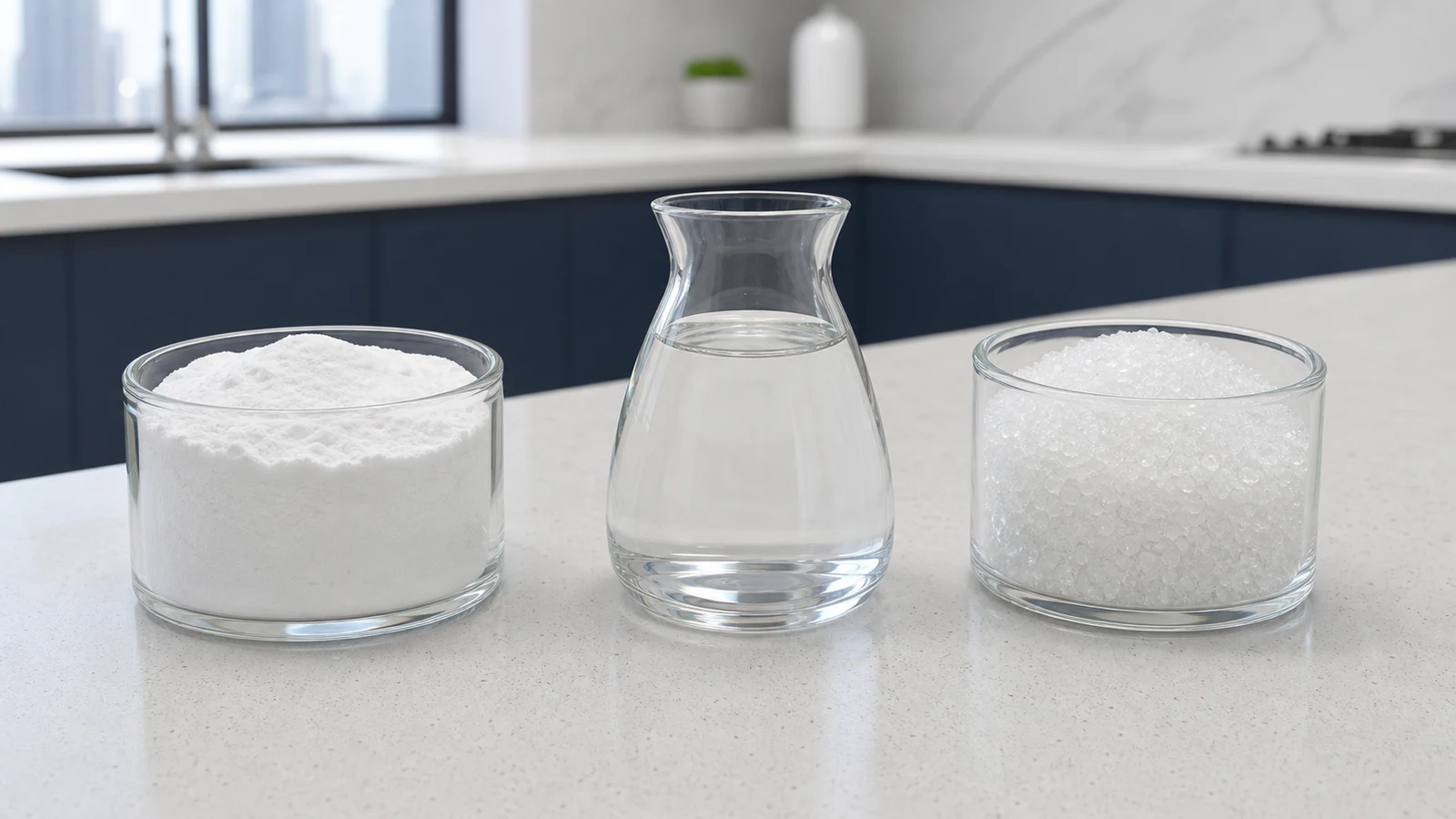
Baking soda, vinegar and citric acid are not interchangeable household solutions. One is a mild alkaline abrasive; the others are acids. Their usefulness depends on concentration, contact time, the actual soil and, most importantly, the substrate and finish. This guide explains those boundaries and routes each real task to a tested, material-specific method.
Quick answer
Which cleaner should I use—baking soda, vinegar or citric acid?
Use none of them until the surface and finish are identified. Baking soda can abrade coatings, while vinegar and citric acid can etch natural stone and affect grout, metals and appliance parts. Mixing an acid with baking soda mostly neutralises both. Prefer the maker's labelled cleaner, exact dose, contact time, rinse and stop conditions.
Room-by-room library
Start with the surface or problem in front of you.
Each section gives the direct rule first, then points to the complete photographed fixes in this cluster.
-
What is baking soda and how does it clean?
Choose a cleaner by both chemistry and surface compatibility. Baking soda is mildly abrasive, while vinegar and citric acid are acids; combining them does not create a stronger cleaner. How to Clean a Greasy Oven Safely — Is Baking Soda Allowed?: Do not choose a universal dwell time. Use baking soda only when the exact oven manual permits it, at that manual's ratio and time; Samsung documents equal parts baking soda and water for 20 minutes on certain ovens. Other makers prohibit that shortcut or require a built-in cycle. Keep every cleaner off elements, vents, seals and unapproved liners. How to Brighten Dark Grout on a Kitchen Backsplash Safely: Identify the tile, grout and sealer, then use a pH-neutral cleaner labelled for all three. Apply it at the label dilution, agitate gently with a soft nylon brush, rinse fully and let the grout dry before judging the colour. If sound grout is still discoloured, use only a compatible labelled grout colourant and follow its preparation and cure instructions. How to Whiten Dark Floor Grout Without Machines: Identify the tile, grout and sealer, then hidden-test their approved neutral or alkaline grout cleaner at the exact label dilution. Work in small sections with a soft nylon grout brush, use only the stated dwell time, rinse until no residue remains and dry the floor. Stop for softness, crumbling, colour loss, dampness or mould.
-
What do vinegar and citric acid do, and why are they different from baking soda?
How to Remove Limescale From a Tap Without Damaging the Finish: Check the exact faucet care guide before using vinegar. If it permits vinegar, use its stated dilution and contact time; Kohler specifies a 50/50 white-vinegar-and-warm-water solution on a soft cloth for about 5–10 minutes. Rinse immediately and dry. If the maker prohibits acetic acid or the finish is unknown, use its approved cleaner instead. Cloudy Shower Glass: A Finish-Safe Hard-Water Cleaning Method: Identify the enclosure and coating first. Wipe with a soft cloth and mild detergent diluted in warm water, then rinse and squeegee dry. Use a hard-water cleaner only when the glass manufacturer approves that exact product and dwell time. Stop for chips, cracks, coating changes or haze that remains after two gentle cleans. How to Descale a Shower Head and Get Your Water Pressure Back: Start by rubbing flexible spray nozzles and rinsing the face with water. If deposits remain, identify the exact shower-head model and follow its care guide. Some manufacturers approve a measured vinegar-and-water soak; others specify different care. Stop for unknown finishes, fixed heads, leaks, damaged threads or weak flow at several fixtures. Brown Ring in the Toilet Bowl: A Glaze-Safe Cleaning Method: Confirm the bowl is intact vitreous china and remove any in-tank product. Flush away previous cleaner, ventilate, then apply only a toilet-bowl hard-water cleaner approved by the fixture maker. Follow its label for amount and contact time, brush with nylon, flush and rinse. Stop for cracks, glaze change or an unknown prior chemical. How to Descale a Kettle Safely: Is Citric Acid Allowed?: Use citric acid only if the exact kettle manual approves it or specifies a compatible citric-acid descaler. Follow the stated dose, water level, heating or no-heating step, contact time and rinse sequence. Keep the base and connectors dry, allow hot liquid to cool, and stop for leaks, coating damage or failed shutoff.
-
Why does mixing baking soda and vinegar create a fizzing reaction, and does it clean better?
Slow Kitchen Drain? What Actually Works (Hint: Not Baking Soda + Vinegar): Baking soda and vinegar do not create useful pressure in an open drain. Remove strainer debris first. For a slow sink with an undamaged plastic slip-joint P-trap, place a bucket below, photograph washer positions, clean the trap, reassemble without overtightening and test for leaks. Stop if chemicals, backflow, corrosion or multiple slow fixtures are involved.
-
Which surfaces are safe for baking soda?
Sticky Grease on Kitchen Cabinets: Clean It Without Ruining the Finish: Identify the cabinet finish and check its care guide. Start with a soft cloth barely dampened with warm water; use only the maker-approved dilution of mild dish soap if needed. Apply liquid to the cloth, not the door, then wipe with clean water and dry immediately. Stop for colour transfer, tackiness, swelling or sheen change. How to Whiten Shower Grout — The Full Method: Identify the tile and grout, then use a neutral tile-and-grout cleaner approved by their manufacturers. Patch-test, apply at the label dilution, agitate gently with a soft hand brush, rinse thoroughly and dry. Stop if grout is cracked, missing, soft, powdery, persistently wet or changes colour during the test.
-
Which surfaces are safe for vinegar and citric acid?
How to Make Chrome Taps Shine Like New in 10 Minutes: Confirm the faucet is intact chrome, then wipe it with a soft cloth dampened with water and a small amount of mild liquid dish soap. Rinse immediately with a second damp cloth and dry completely. Do not use vinegar, limescale remover, abrasive pads or wax unless the exact faucet manufacturer approves them. How to Restore Shine to a Dull Countertop (Quartz vs. Marble): Confirm the exact material, finish and manufacturer, then use its approved neutral cleaner and a soft cloth. Patch-test first, rinse and dry as directed. Use a polish only when the maker explicitly approves one for that product. Acid can etch calcite-based stone; physical etching, abrasion, heat damage and resin damage need specialist assessment. White or Yellow Stains on the Countertop: The Poultice Method: There is no standard dwell time. Identify the exact countertop, finish, sealer and stain, then use only the poultice chemistry and dwell time specified by that surface supplier. Patch-test the complete method first. If no applicable written instruction exists, do not improvise with baking soda, peroxide, solvent or plastic covering.
-
What surfaces must never be cleaned with vinegar or citric acid?
White or Yellow Stains on the Countertop: The Poultice Method: There is no standard dwell time. Identify the exact countertop, finish, sealer and stain, then use only the poultice chemistry and dwell time specified by that surface supplier. Patch-test the complete method first. If no applicable written instruction exists, do not improvise with baking soda, peroxide, solvent or plastic covering. How to Restore Shine to a Dull Countertop (Quartz vs. Marble): Confirm the exact material, finish and manufacturer, then use its approved neutral cleaner and a soft cloth. Patch-test first, rinse and dry as directed. Use a polish only when the maker explicitly approves one for that product. Acid can etch calcite-based stone; physical etching, abrasion, heat damage and resin damage need specialist assessment.
-
How do you know what material your surfaces are made from?
How to Clear a Stale Closed-Apartment Smell Safely: First rule out gas, burning, chemical, sewage, damp, mould and pest odours. For ordinary stale air, ventilate only when current outdoor air, humidity and security conditions are suitable. Wash care-label-approved textiles, follow the AC manual for user-serviceable filters and remove dust. Investigate persistent, worsening or localised odour instead of masking it.
-
What is the safest cleaning approach for a new home?
How to Clear a Stale Closed-Apartment Smell Safely: First rule out gas, burning, chemical, sewage, damp, mould and pest odours. For ordinary stale air, ventilate only when current outdoor air, humidity and security conditions are suitable. Wash care-label-approved textiles, follow the AC manual for user-serviceable filters and remove dust. Investigate persistent, worsening or localised odour instead of masking it.
What you need
Before you choose
Identify the substrate, coating and appliance or fixture model before choosing chemistry. Keep any product in its original labelled container and measure only the approved amount. Do not store a homemade mixture, reuse food containers or apply a recipe from one material guide to another surface with a similar appearance.
- Baking soda
- Baking soda is a gentle base with mild abrasive properties, making it suitable for degreasing and odour removal.
- Mineral scale
- Vinegar and citric acid are both acids that dissolve mineral deposits, limescale and hard-water stains.
- Fizzing reaction
- Mixing baking soda and vinegar creates a chemical reaction that produces mostly water and carbon dioxide gas—neutralising both cleaners.
- Natural stone
- Acids damage natural stone including marble, limestone, terrazzo, travertine and cement tile.
- Polished finishes
- Baking soda should never be used on polished or sealed surfaces as it may create micro-scratches.
Quick answers
Frequently asked questions.
Is baking soda or vinegar better for cleaning?
Neither is universally better. Baking soda is mildly alkaline and abrasive, while vinegar is acidic; each can damage an incompatible finish. Choose by the soil, substrate, coating and maker instructions. If those are unknown, remove loose debris dry and use a confirmed pH-neutral method rather than selecting chemistry by popularity.
Why shouldn't you mix baking soda and vinegar?
Baking soda reacts with vinegar to produce carbon dioxide, water and salts, so the fizz is not proof of stronger cleaning. The reaction consumes the acid and base. Do not mix or store them as a formula; use a separately approved product and method for the soil and surface.
What surfaces does vinegar or citric acid damage?
Vinegar and citric acid can etch marble, limestone, travertine, terrazzo and other calcium-rich materials. They may also affect cement-based grout, sealers, coatings, metals and appliance components. Compatibility depends on concentration and contact time as well as material, so follow the exact surface or equipment maker rather than a universal list.
Can you use lemon juice the same way as vinegar or citric acid?
Lemon juice is an acidic food product, not a measured substitute for a labelled cleaner. It can etch natural stone and affect grout, metals, coatings or seals. Do not assume glass or stainless steel is universally compatible. Use the maker-approved product, dose, contact time and rinse method for the surface.
Sources and review notes
- Bosch: What Oven Cleaner Should I Use? - Manufacturer guidance for warm soapy water, spot cleaning and model-specific self-cleaning.
- Samsung: How to Clean a Samsung Oven - Manufacturer instructions for cool surfaces, nonabrasive tools and a short baking-soda method on covered models.
- Whirlpool AquaLift Clean Cycle Instructions - Primary instructions requiring measured water without chemical additives and a complete cool-down.
- LATICRETE Cement Grout Care and Maintenance - Manufacturer guidance for pH-neutral routine cleaning and material-specific stain treatment.
- LATICRETE Ceramic and Porcelain Tile Care - Manufacturer care limits for tile, grout and sealer, including unsuitable household cleaners.
- MAPEI UltraCare Grout Refresh Technical Data Sheet - Primary product instructions for compatible substrates, preparation, application, PPE and cure.
- Tile Council of North America: Cleaning Grout - Recommends conventional compatible cleaning, thorough rinsing and warns that acids attack cement grout.
- MAPEI: UltraCare Concentrated Tile & Grout Cleaner - Grout-system manufacturer documentation identifying a neutral cleaner for routine tile and grout maintenance.
- Kohler: Hard Water, Calcium or Mineral Buildup on Faucet - Manufacturer instructions for a brief 50/50 white-vinegar-and-warm-water treatment.
- hansgrohe: Care and Cleaning Guide for Faucets and Bathroom Products - Manufacturer guidance requiring soft cotton, clean-water rinsing and citric-acid products instead of acetic acid.
- Moen Faucet Finish Care and Cleaning - Manufacturer finish-specific restrictions and limited diluted-vinegar guidance.
- KOHLER: How to Clean Glass Shower Doors - Manufacturer guidance for mild diluted detergent, squeegeeing and drying shower doors to limit water spots and lime buildup.