
DIY / Kitchen
White or Yellow Stains on the Countertop: The Poultice Method
A poultice is not a universal countertop remedy. Its absorbent material, liquid, covering method and dwell time depend on the exact stone or engineered surface, sealer and stain. This guide is a controlled workflow for following an identified supplier's instructions, not a baking-soda or peroxide recipe.
Quick answer
How long do you leave a baking soda poultice on?
There is no standard dwell time. Identify the exact countertop, finish, sealer and stain, then use only the poultice chemistry and dwell time specified by that surface supplier. Patch-test the complete method first. If no applicable written instruction exists, do not improvise with baking soda, peroxide, solvent or plastic covering.
An identified intact surface with written supplier approval for the exact poultice / A confirmed stain type covered by that supplier instruction
Unsealed or unknown countertop material / Polished marble or surfaces with visible damage / Countertops near seams, cracks or temperature-sensitive edges / Surfaces where the sealer type is unknown
What you need
What you need
Use only the absorbent material, cleaning agent, applicator and covering method named in the exact surface supplier's instruction. Do not substitute baking soda, peroxide, solvent or plastic film. Read the chemical label and SDS before starting.
- Difficulty
- Easy
- Active time
- 10 minutes
- Total time
- Product-specific; follow the approved instruction
Supplier-approved poultice absorbent for the identified surface and stain
as specified
Supplier-approved liquid or cleaner
as specified on its label
Covering material only if the surface instruction requires one
as specified
Small mixing bowl (any material)
1
Spoon or small palette knife
1
Paper towels
as needed
Chemical-resistant gloves and splash goggles specified by the product label
1 pair
Typical UAE retail ranges. Prices vary by pack and store, and your total is lower when you already own the reusable tools.
Step by step
How to Remove White or Yellow Stains from the Countertop Using a Poultice
Work in a well-ventilated area, wear disposable gloves, and always test this method on a hidden section first.
-
Step 01
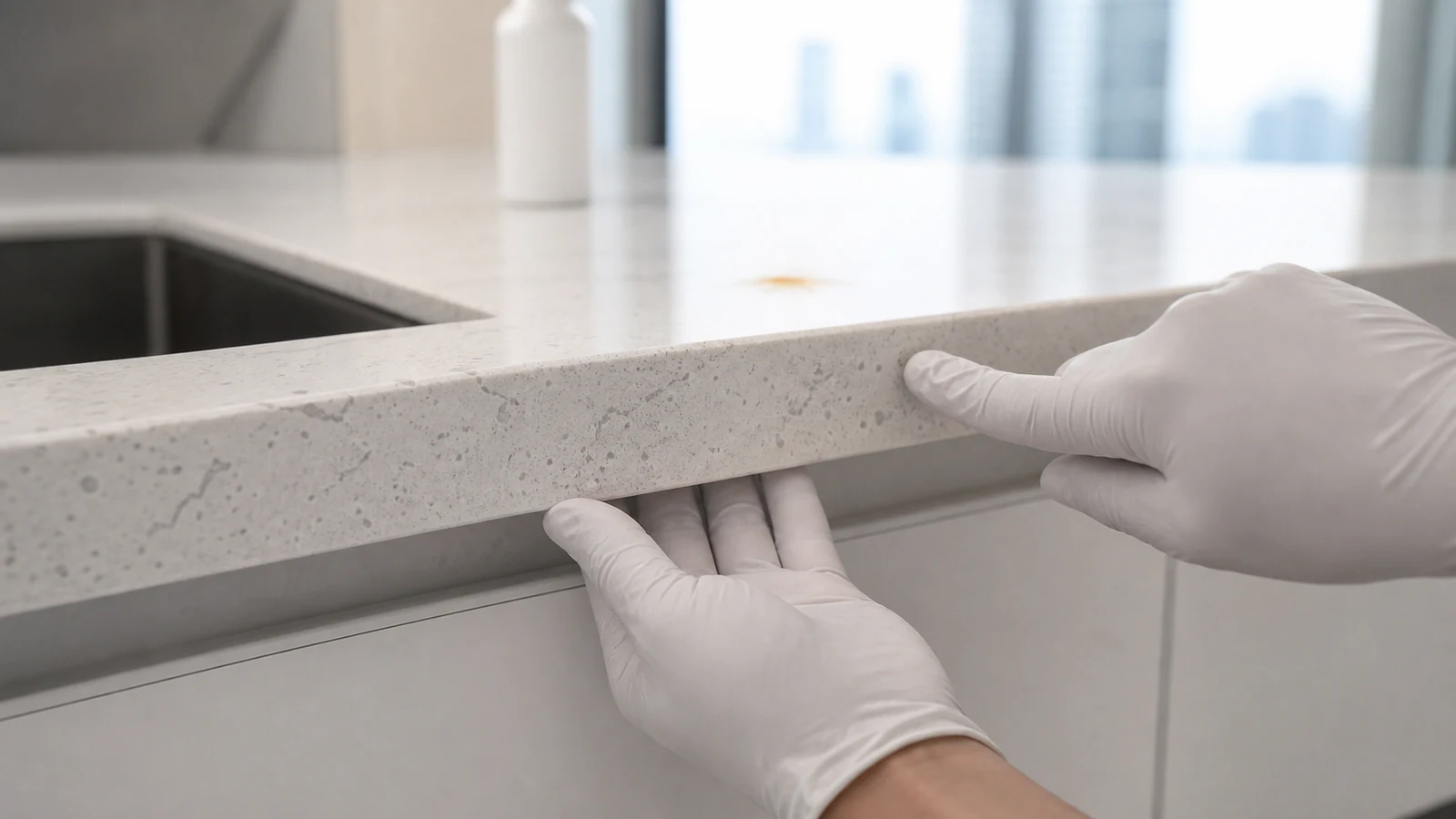
Identify your countertop material and sealer
Look for a label under the sink or ask the previous owner or builder. Quartz, marble, granite, limestone and travertine all require different poultice formulas and safety limits. If you cannot identify your surface, do not proceed. Contact the manufacturer or a local stone specialist for guidance.
You can name the exact material type
You have located the sealer brand or manufacturer information
-
Step 02
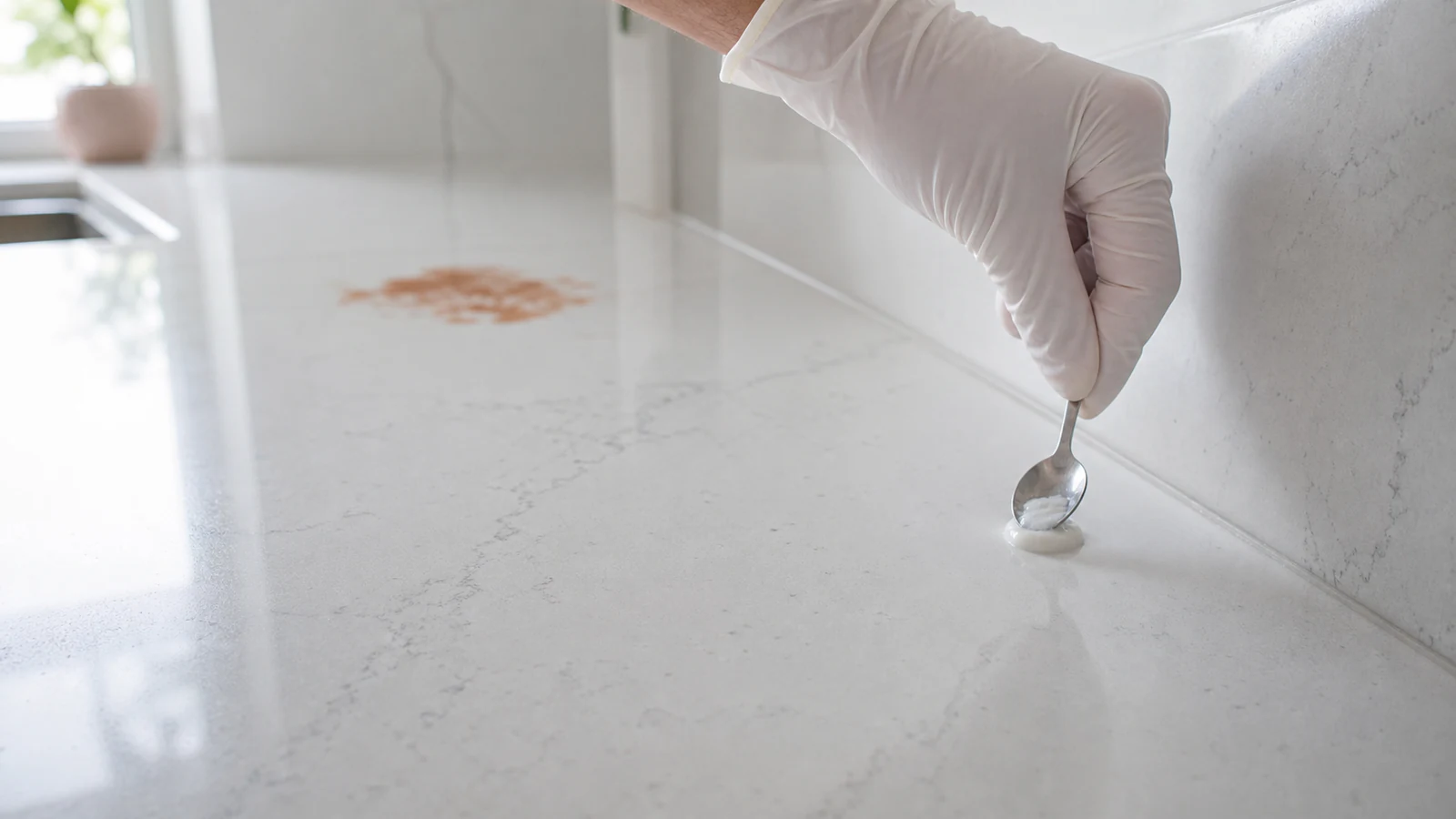
Perform a patch test on a hidden area
Prepare a tiny amount using the exact supplier formula. Apply it to an inconspicuous area, including the same cover only if instructed. Use the specified dwell, removal and drying times. Inspect for colour, gloss, texture or sealer change. Stop if anything changes.
The test area looks identical to the surrounding countertop after drying
No whitening, darkening, dull spots or texture change is visible
-
Step 03
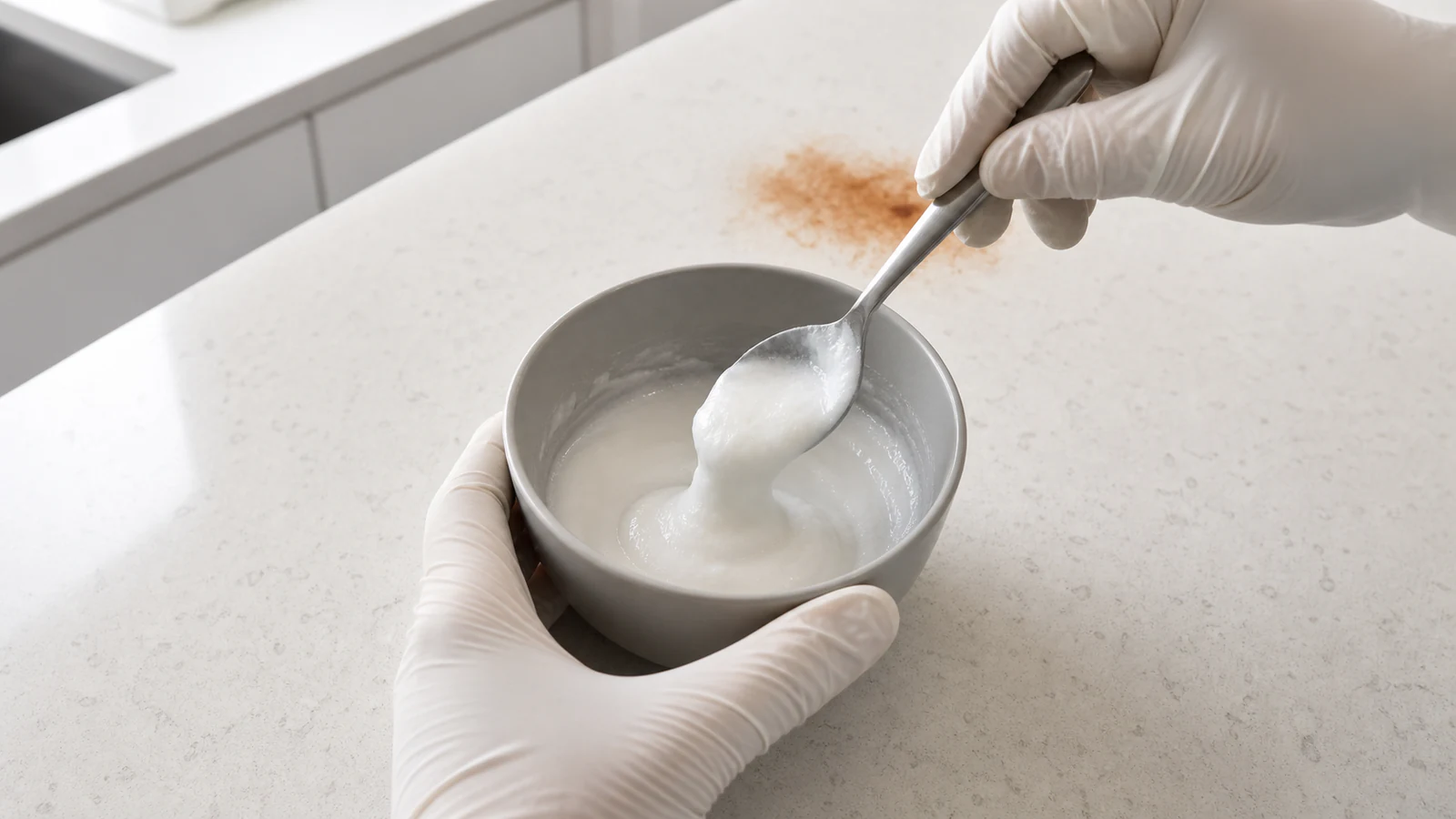
Prepare only the documented poultice formula
Ventilate and put on the PPE stated by the liquid's label and SDS. Measure the supplier-specified absorbent and liquid exactly, using the specified container and applicator. Never add peroxide, bleach, vinegar, ammonia, alcohol, solvent or another cleaner unless that exact combination is written in the applicable instruction.
The mixture matches the supplier's stated ratio and consistency
Only the documented components and applicator are in use
-
Step 04
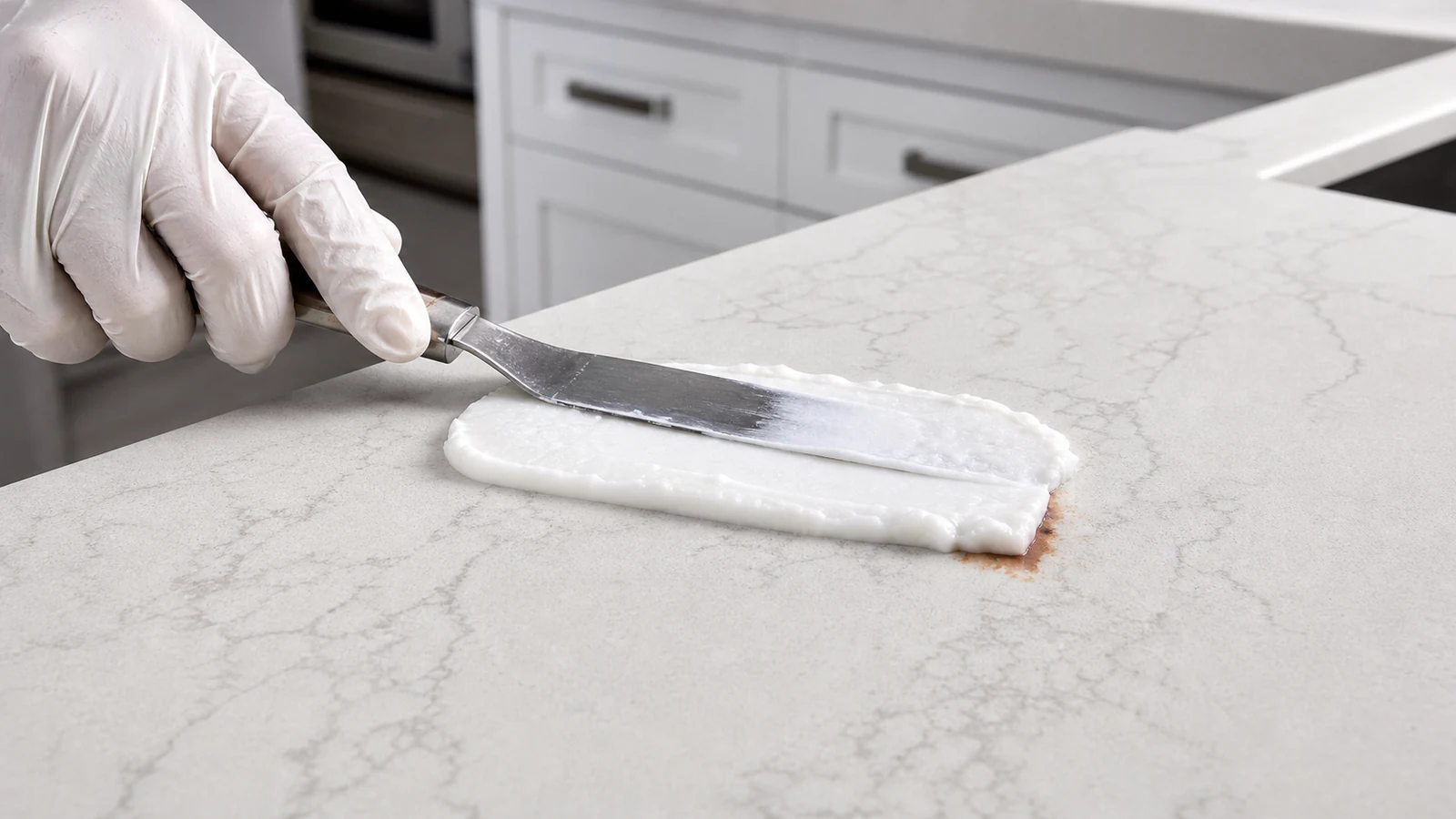
Apply the poultice to the stain
Use the approved applicator to place the poultice over the stain at the thickness and margin stated by the surface supplier. Keep it away from seams, cracks and edges. Stop if the surface darkens, lightens, swells, softens or changes sheen during application.
The stain is completely hidden under a smooth paste layer
The paste is uniform in thickness and wet to the touch
-
Step 05
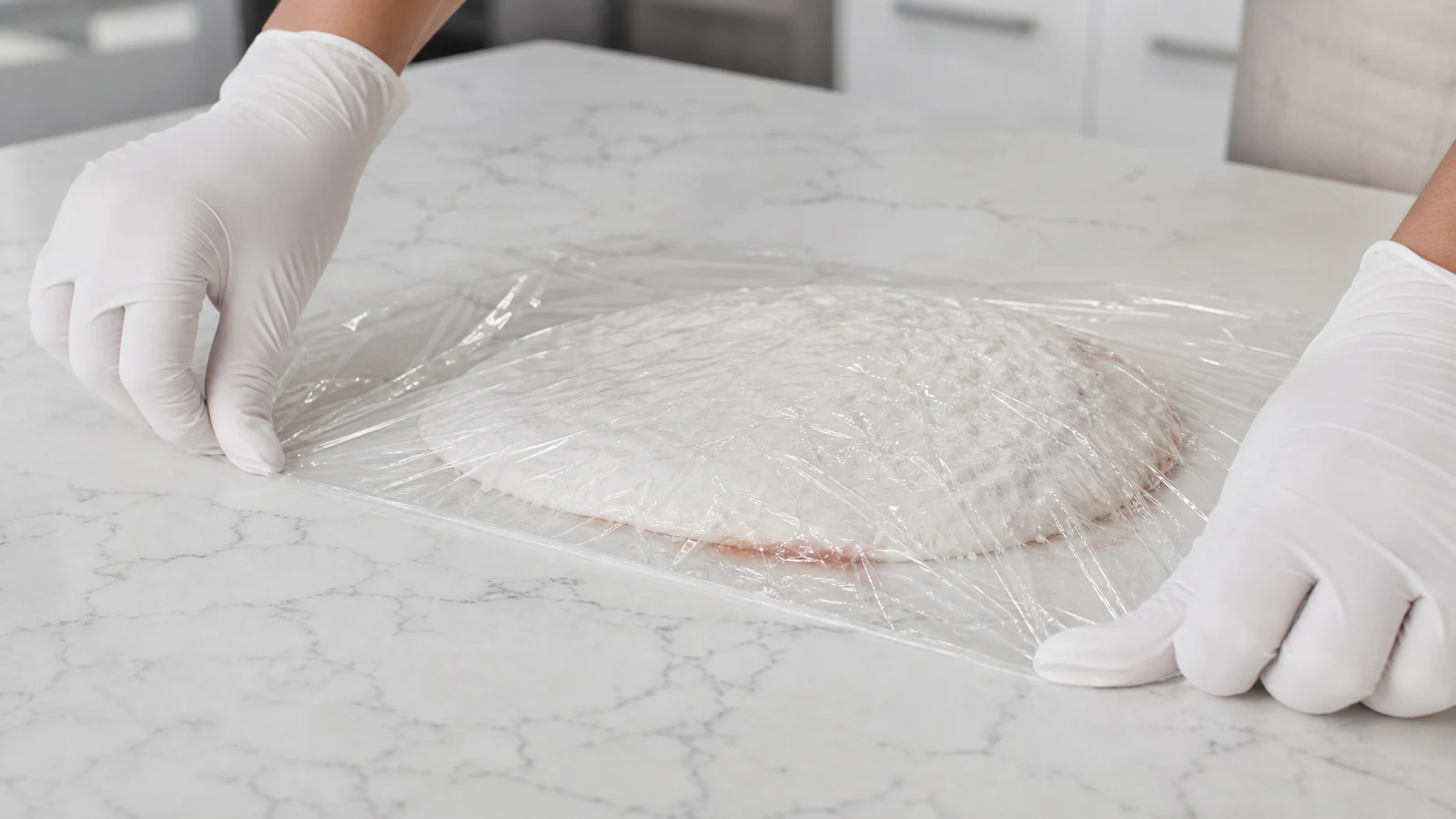
Cover only when the approved instruction says to
Some poultices are covered for part of the cycle and others are not. Follow the exact instruction for cover material, venting, edge treatment and removal time. Do not seal a peroxide, solvent or other reactive mixture unless the applicable manufacturer instruction explicitly requires it.
The plastic is taut and fully sealed at all edges
No gaps or air pockets are visible around the perimeter
-
Step 06
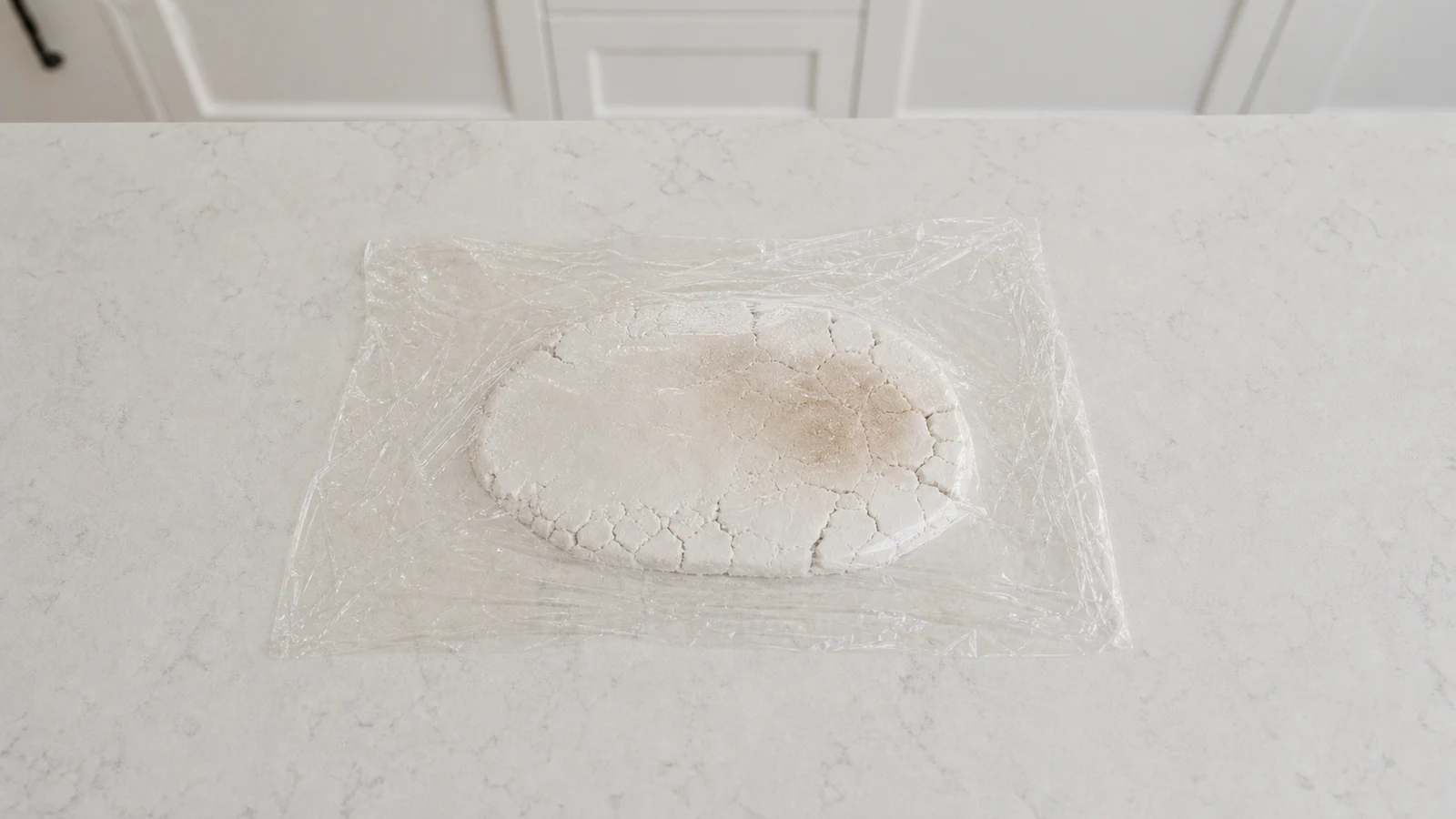
Wait without disturbing the poultice
Use only the dwell and uncovering schedule in the applicable instruction; there is no fallback estimate. Keep heat and water away and prevent children or pets from reaching the area. Stop at the first colour, texture, odour, seam or finish change. If guidance is missing, remove the test as its label directs and do not continue.
The entire dwell time has elapsed
The paste has become noticeably drier and may show cracks
-
Step 07
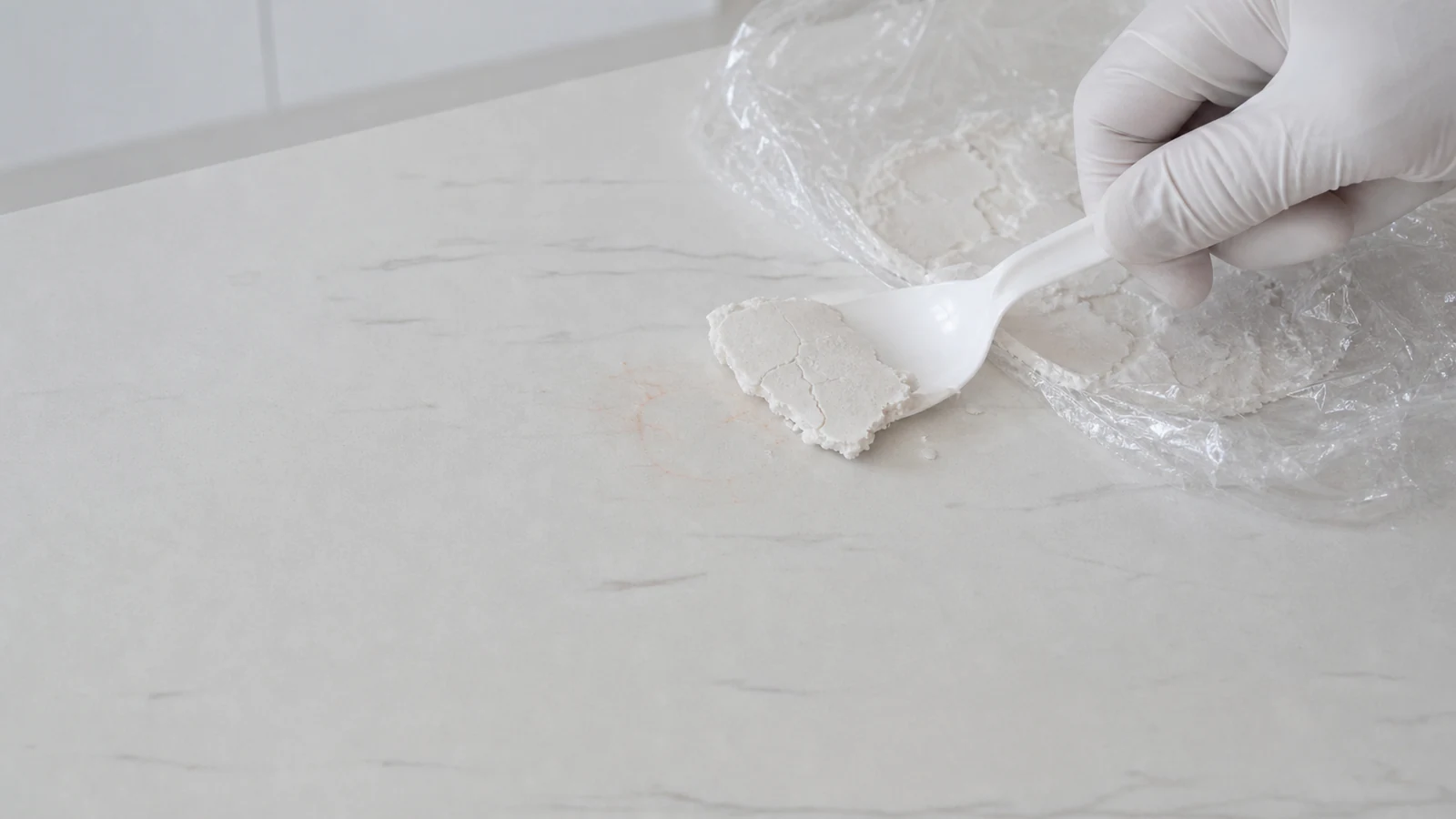
Remove the poultice and assess the result
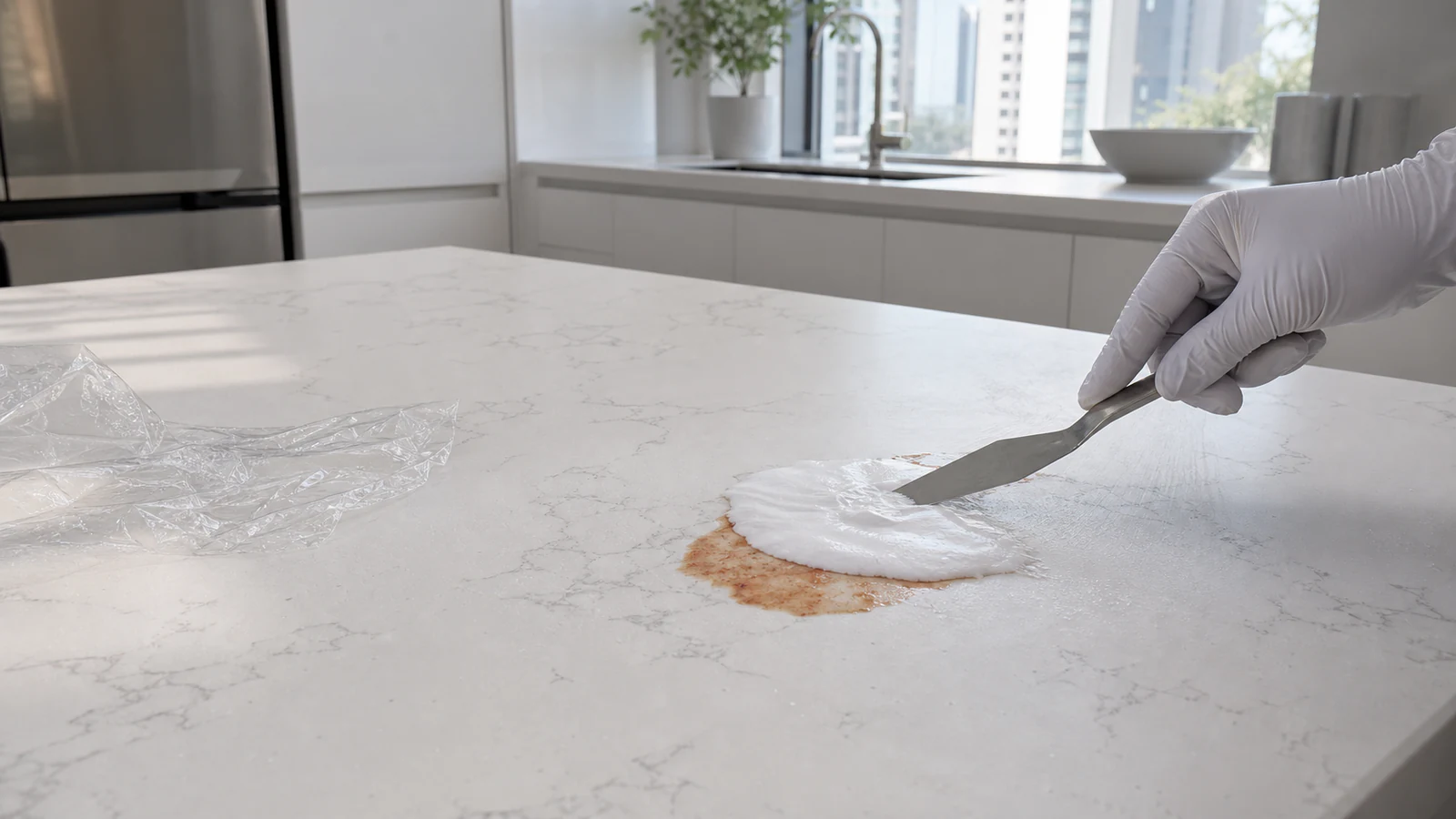
Peel away the plastic wrap and set it aside. Using a soft spoon, gently scrape away the dried poultice. Do not scrub or use abrasive tools. Rinse the area thoroughly with clean water on a soft cloth and dry immediately with paper towels. Inspect the stain to see if it has lightened.
All dried poultice paste has been removed
The countertop surface is completely dry
You can see whether the stain has lightened or remained unchanged
Finished result
What success looks like
A successful poultice treatment lightens or eliminates the visible stain without altering the countertop's colour, gloss, texture or finish.
The stain is noticeably lighter or no longer visible
The countertop surface has the same colour and finish as the surrounding area
No dry patches, whitening or dull spots remain
The surface is smooth to the touch with no residue or paste film
No cracks, swelling or damage is visible at seams or edges
Troubleshooting
When the first pass does not solve it.
The stain has not lightened after one full cycle
The poultice may not be the correct formulation for this stain type or material. Some deep or old stains cannot be fully removed by poultice alone.
Do not repeat the process. Contact the countertop manufacturer or a local stone restoration specialist.
The countertop has a white, chalky or dull patch where the poultice was applied
The paste may have dried out the surface, or the material may have reacted to the poultice. Some surfaces lose gloss temporarily when moisture is withdrawn.
Remove residue as the product label directs, allow the area to dry fully, and stop. Do not add sealer. Contact the countertop manufacturer or a stone-restoration specialist with photographs of the patch.
Quick answers
Frequently asked questions.
How long do you leave a baking soda poultice on?
There is no standard dwell time for a baking-soda poultice. Use a poultice only when the exact surface supplier specifies the absorbent, liquid, cover and dwell for that stain and sealer. Patch-test the full method, wear label-specified PPE and stop if colour, gloss or texture changes.
How do you get turmeric stains off a countertop?
Blot a fresh turmeric spill and use the countertop maker's approved routine. Do not assume peroxide or baking soda suits the resin, stone or sealer. For a set stain, give the maker the product name and stain age. Stop after one approved test if it does not improve.
What removes oil stains from stone?
Blot fresh oil without spreading it, then follow the exact surface supplier's stain guidance. Natural Stone Institute guidance uses stain-specific absorbents and cleaning agents, but engineered surfaces and sealers may require different chemistry. Do not improvise a dry powder or solvent poultice; ask the maker or a stone professional.
Can you use hydrogen peroxide on all countertops?
No. Peroxide can change stone, pigment, resin or sealer and must never be mixed with other cleaners. Use it only when the exact countertop or stone supplier explicitly specifies its concentration, formula, cover and dwell for that material and stain. An unknown surface has no safe fallback poultice.
Sources and review notes
- Natural Stone Institute: stain identification and poultices - Industry guidance showing that poultice chemistry depends on the identified stain and stone.
- Caesarstone quartz surface care and maintenance - Manufacturer guidance for engineered quartz; it supports using product-specific care rather than importing natural-stone recipes.
- Natural Stone Institute: natural stone care - Material identification, chemical compatibility and escalation guidance for stone surfaces.